Do you find your TEAS study guide helpful? Not every student does… so you are not alone if you feel confused or overwhelmed.
Here, you are going to learn how to read a study manual so that you can predict the questions types.
This is part 3 in a series on creating your best teas study plan for the ATI TEAS. Read Part 1 here: How to study for the TEAS. You can read part 2 here: TEAS study plan time management.
In this lesson you’re going to start really diving into sneaky ways to study smarter. You’re going to learn to study in a way that most people never learn how to do. Excited!?
Feel free to grab yourself a coffee and a little snack because this lesson is more intensive. Also, thank you for working so hard to create your study plan! High five!
If you’ve worked through Part 1 and Part 2, you’ve…
- Committed to finding the time to study for the TEAS because you know getting a solid score will make your life better.
- Prepared to dedicate at least 50-75 hours to studying, and you’ve scheduled time on a calendar.
- Learned that practice tests and questions aren’t enough… because you need focused learning, review, and strategy, too.
But now what? What do you actually study? And how?
Many times, students don’t really know what to study. Guess what happens when you Google “How to study for the TEAS”? You get 4.6 million hits of advice!
The truth is, the material IS overwhelming. And now that you know the Four Step to Studying Smarter…
- Learn
- Memorize
- Apply
- Strategize
…where do you even start?
Well, there are TEAS breadcrumbs for you if you know where to look. And once you start following them, you can be studying smarter.
When you look at the structure of a TEAS study guide, you can see helpful ways to study.

Before we get started, I want to speak a bit about study materials. My assumption is that you’ve already bought (or seen) the official study manual.
After all, most people start with the official stuff first then looking for extra help from random people on the Internet (hiiii! 👋)
If you have a study guide in front of you, fantastic. Follow along. If not, pay attention so that you can apply these steps when you get a guide.
See, the TEAS is a standardized test, which means that it has to follow a certain formula in order to make sure everyone gets different questions at the same level of difficulty.
One way the TEAS does this is by assigning how deeply you, the test taker, need to know a subject.
Let’s take a look at a specific example so that it’s clear for you. For example, you need to know a specific level of chemistry for the TEAS science section.
The good news is that you don’t need to understand processes and problem-solving steps at the level of, say, a student who is majoring in chemistry (whew). Instead, your level of knowledge is largely around comparing and contrasting, like…
- Compare and contrast the characteristics of solids, liquids, and gasses
- Compare and contrast the characteristics of acids and bases
So what does this mean for you? Well, you can probably expect to see questions on the TEAS that talk about, say, a solid compared to a liquid, NOT a solid by itself. You need to know how they relate to each other.
If you studied them separately, you might be caught off guard by the actual test question.
You’ll know you’ve studied the right way when you can say things like, “Solids and liquids both ___________, but only liquids ___________.”
In the chart on the next page, you’ll see how study guide code words translate to different types of TEAS questions.
Each group of keywords indicates a different level of depth and a different study strategy.
The code comes down to language.
To understand this code better, take a look at the table below.
TEAS Helpful Tip: Use the Study Code
TEAS Study Guide Code Words
Identify, Recognize ➜ Questions on matching, defining, or recognition
✰ Memorize defining characteristics
✰ Know vocab & glossary terms
✰ Use flashcards for drills
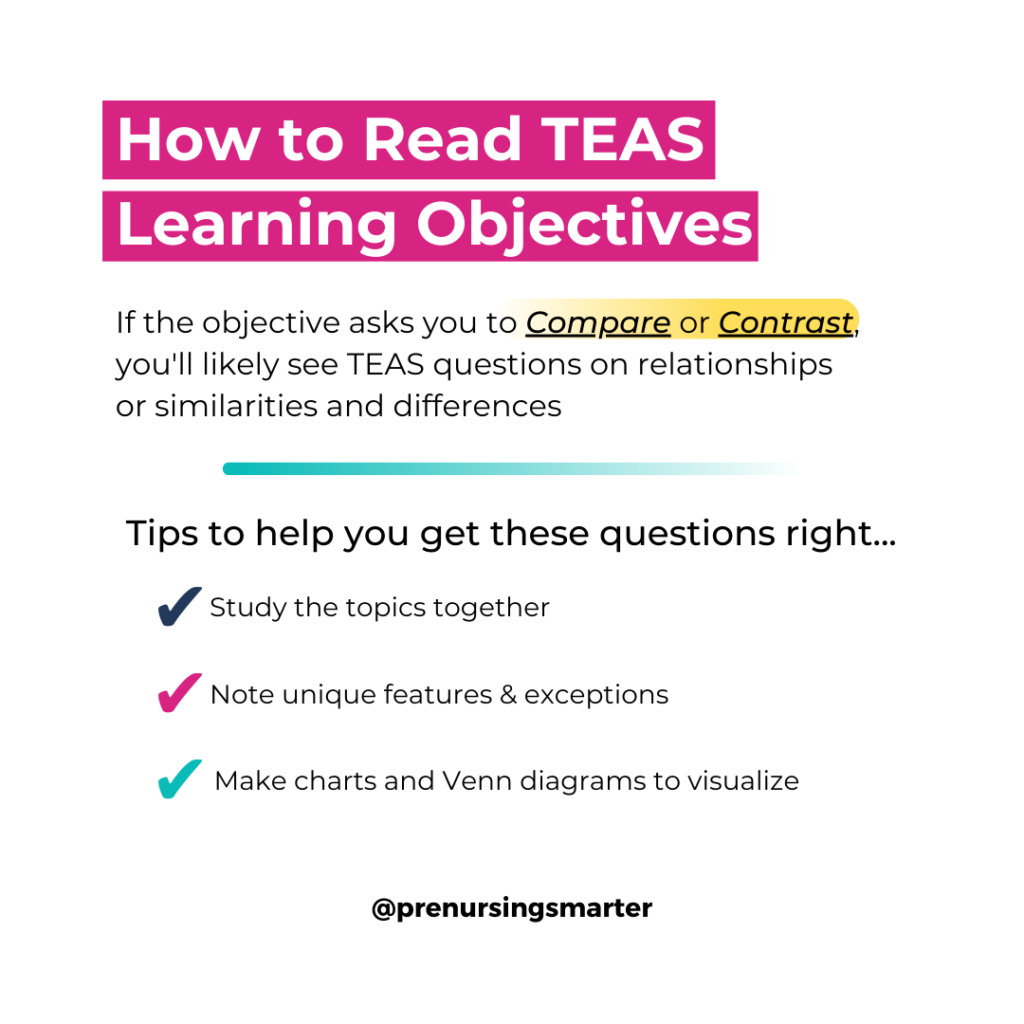
Compare and Contrast ➜ Questions on relationships or similarities and differences
✰ Study the topics together
✰ Note unique features & exceptions
✰ Make charts and Venn diagrams to visualize
Explain, Evaluate, Demonstrate, Describe ➜ Questions on relationships or similarities and differences
✰ Study the topics together
✰ Note unique features & exceptions
✰ Make charts and Venn diagrams to visualize
Interpret, Locate ➜ Questions that require reading a chart or graph and/or applying the information
✰ Learn tactics to read charts & graphs quickly
✰ Learn strategies to avoid time-wasting traps
As you move down the table, the types of TEAS questions you’ll have harder.
For example, it’s easier to memorize terms and definitions that you’ll be asked to match. It’s harder to interpret a graph, as that often requires knowledge and critical thinking.
The good news is that the table gives you big hints and how you’ll need to study for the TEAS.
For example, in order to study solids, liquids, and gasses, you’d be well served to make a chart of each of these 3 phase states and their specific characteristics so that you learn the concepts together.
(Pssst, the same thing goes for DNA, genes, and chromosomes!)
Your turn to apply these TEAS helpful tips!
Open up your study manual and start makin’ a list! Then, start making a list. You’ll make your TEAS study guide helpful rather than confusing.
- Use the Teas Study Code in the table above.
- Grab some scrap paper and a pen or pencil—or make a spreadsheet with Google Docs or Excel.
- Pick one of the subjects to start: Reading, Math, Science, English.
- Start grouping topics by the study language used to introduce the topic.
- Put stars next to all the topics that say “Explain, Evaluate, Describe, or Demonstrate.” These are the concepts most emphasized by the TEAS, and you’ll need to understand the systems and the steps in order to score well.
- Make a list of key terms, terms in bold, or concepts that require “Identifying” or “Recognizing.” These are great for flashcards and straight memorization.
- Keep a list of concepts that require “Compare and Contrast.” Study them together…because you’ll very likely be asked about how they relate to each other on the TEAS.

Good luck! You’re going to start to see how the TEAS is put together, and you’re going to create a plan for yourself!
By the way, if you are visual learning, I have some visual TEAS study guide resources here.
You’ll feel so much more comfortable when you aren’t just cramming random facts in your head and hoping they stick; you’ll have a system.
In the next lesson, we’re going to get more detailed about this system and start sorting the information into tiers. We’re going to talk about how to avoid a HUGE mistake many students make when studying.
P.S. This is the foundation of ALL the lessons in the premium prep program. Check it out if you’d like to study this way… with all the organizational work already done for you.